
Dual-Axis Navigation System
The Molecular Matchmaker uses a coordinate-based approach to visualize pairing relationships. One axis represents acidity and fat content, while the other maps complexity levels across different combinations.
By positioning elements along these axes, users can identify which wine and cheese pairings fall into specific flavor coordinates. This systematic approach helps predict compatibility before tasting.
The tool functions as an educational reference, demonstrating how chemical and structural properties influence sensory perception when elements are combined.

Coordinate System Framework
Acidity-Fat Axis
This dimension measures how wine acidity interacts with cheese fat content. Higher acidity wines can balance richer cheeses, while lower acidity wines complement lighter varieties.
Complexity Axis
Complexity levels range from simple, straightforward profiles to intricate, multi-layered combinations. Matching complexity ensures balanced pairings where neither element dominates.
Coordinate Mapping
Each pairing occupies a specific position within the coordinate space. Adjacent coordinates often share similar characteristics, creating clusters of compatible combinations.
Interactive Exploration
Users can adjust sliders to explore different regions of the coordinate space, revealing which pairings align with specific acidity-fat and complexity parameters.
Practical Application
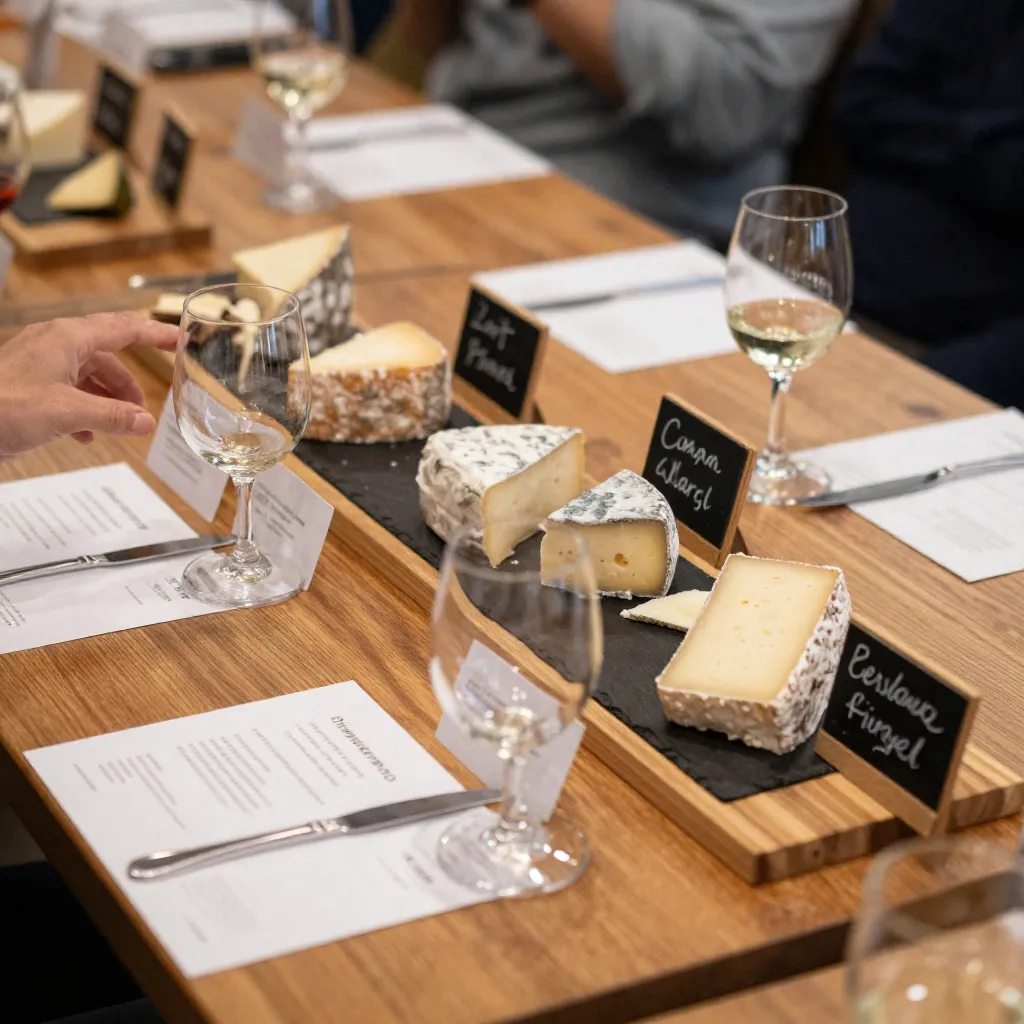
Using the Navigator
Begin by identifying the acidity level of your wine selection. Then determine the fat content of your cheese. These two values establish your position on the first axis.
Next, assess the complexity of both elements. Simple wines pair well with simple cheeses, while complex combinations can create interesting interactions when balanced appropriately.
The coordinate system helps predict which combinations are likely to work well together, serving as a starting point for exploration rather than a definitive rule.
Learning Through Visualization
The coordinate-based approach makes abstract flavor relationships more tangible. By seeing how different pairings cluster in the coordinate space, users develop intuition about compatibility patterns.
Pattern Recognition
Visualizing pairings in coordinate space helps identify patterns and relationships that might not be immediately apparent through tasting alone.
Systematic Exploration
The structured approach encourages methodical exploration of different regions within the pairing space, ensuring comprehensive coverage of possibilities.
Educational Foundation
Understanding the underlying principles supports informed decision-making and helps explain why certain combinations work well together.